
MLM Meaning: A Clear Guide to Multi‑Level Marketing
Hey! If you’ve ever heard someone talk about “MLM” and felt confused, you’re not alone. The term gets tossed around in coffee chats, Facebook groups, and ads, but many people still wonder what it really means. In this guide we’ll break down the MLM meaning, show how the business model works, compare it to illegal pyramid schemes, weigh the upside and downside, and give you a checklist to stay safe.
By the end you’ll know exactly how an MLM is structured, what to expect from compensation plans, and how to decide if joining one fits your goals.
What Is MLM? Definition and Core Model
MLM stands for multi‑level marketing. It’s a direct‑selling approach where independent distributors earn money not only from the products they sell, but also from the sales made by the people they recruit into their “downline.” The word “multi‑level” refers to the multiple layers of recruitment that form a pyramid‑shaped hierarchy.
According to Wikipedia’s definition of multilevel marketing, participants act as both sellers and recruiters. They receive a commission on their own sales and a smaller commission on the sales of their recruits, and sometimes on the sales of recruits further down the line. This creates a chain of earnings that can stretch many levels deep.
Imagine you sell a skin‑care set for $50 and earn a 20% margin. You also bring two friends into the business. Each of them sells a set and you get a 5% cut of their sales. If they each recruit two more friends, you keep earning a smaller percentage on those sales too. The more people you bring in, the larger the network, and the larger the potential income.
Key components of the core MLM model include:
- Product or service:Most legitimate MLMs have a tangible product line that distributors sell directly to consumers.
- Recruitment:Distributors are encouraged to recruit new members, who become part of the recruiter’s downline.
- Compensation plan:The rulebook that tells you how commissions flow up the pyramid.
- Training and support:Many companies offer webinars, manuals, and mentorship to help distributors succeed.
Because the earnings come from two sources, personal sales and team sales, MLM can feel like a hybrid between a retail job and a small‑business franchise. But the balance between product sales and recruitment varies wildly from one company to another.
And if you’re thinking about diving in, you’ll want to see how the compensation plan is built. That’s what we explore next.
How MLM Compensation Plans Work
Compensation plans are the engine that turns a flat network into cash flow. While every company writes its own rules, most plans fall into a few familiar shapes.
One of the simplest is theunilevel plan. In this model you can recruit an unlimited number of distributors directly under you, your “first level.” Those recruits can each add their own first‑level members, creating a second level for you, and so on. You typically earn a percentage of sales up to a set depth, often between the fourth and eighth level.
For example, a unilevel plan might pay 5% on sales you make, 3% on the sales of your first‑level recruits, 2% on the second level, and 1% on the third. After the third level, the flow stops. The upside is that the structure is easy to explain; the downside is you only get paid on a limited number of layers.
Contrast that with abinary plan. Here you have two “legs”, a left and a right. Each new recruit must be placed in one leg, and you earn commissions based on the sales volume of the weaker leg. If your left leg sells $5,000 and your right leg sells $8,000, you’re paid on the $5,000. The goal is to keep both legs balanced so you can maximize the payout.
Binary plans often include “spillover,” where extra recruits that can’t fit in your first level automatically flow into the next available spot in the weaker leg. This can accelerate growth, but it also means you rely on the strength of the whole team, not just your own efforts.
Another popular format is thematrix plan. You fill a fixed‑size grid, say 3 × 3, by recruiting a set number of members. Once the matrix is full, you receive a bonus and move to the next board. Matrix plans can create rapid expansion, but they also cap the number of people you can directly sponsor.
Here’s a quick checklist to evaluate any MLM’s compensation plan:
- Does the plan reward personal product sales first, or does it lean heavily on recruitment?
- How many levels are paid, and what are the percentages at each level?
- Are there caps on earnings or on the size of your downline?
- Is the plan easy to explain in under two minutes? Simplicity often signals transparency.
Understanding these mechanics helps you predict cash flow and spot hidden pitfalls before you sign up.

MLM vs. Pyramid Schemes: The Legal Distinction
One of the biggest questions new distributors ask is how an MLM differs from an illegal pyramid scheme. Both involve recruitment, but the law draws a clear line based on product sales.
The U.S. Federal Trade Commission (FTC) states that a legitimate MLM must have a genuine product or service that is sold to real customers who are not merely recruited distributors. In a pyramid scheme, the primary “product” is the act of recruiting itself, and money moves upward from new members to those at the top, with little or no retail sales to outside consumers.
According to the FTC’s consumer‑education page on pyramid schemes, a red flag is when earnings are tied mostly to the number of people you recruit rather than the volume of product you sell. Another warning sign is a requirement to buy large starter kits or inventory that you can’t realistically sell.
Let’s break the comparison down in a table:
Even with these rules, the line can blur. Some MLMs push heavy recruitment while still offering a product, which can feel like a gray area. That’s why you need to dig into the company’s sales data, read the fine print, and ask pointed questions about real‑world customer demand.
And if you ever feel the model leans too much toward recruitment, that’s a cue to step back.
Pros and Cons of MLM Participation
Like any business model, MLM has strengths and weaknesses. Understanding both sides helps you decide if the lifestyle fits your goals.
Pros
- Low entry barrier:You can start with a modest starter kit, often under $200, and work from home.
- Flexibility:You set your own schedule, making it appealing for stay‑at‑home parents or side‑hustlers.
- Personal development:Many MLMs provide mindset training, sales coaching, and leadership workshops. Shush Arya’s Coaching Program, for example, blends mindset work with concrete lead‑generation tactics to help new distributors build confidence.
- Potential for residual income:If you build a strong downline, you keep earning commissions on their sales even when you’re not actively selling.
- Community support:Teams often host regular meetings, webinars, and social‑media groups that create a sense of belonging.
Cons
- Income volatility:Earnings depend on both your sales skill and your team’s performance. Many distributors make little or no profit.
- Market saturation:As more people join, the pool of fresh prospects shrinks, making recruitment harder.
- Up‑front costs:Starter kits, inventory purchases, and training fees can add up quickly.
- Reputation risk:Some consumers view MLMs skeptically, which can affect your personal brand.
- Time investment:Success often requires daily outreach, social‑media posting, and team coaching.
Weigh these points against your personal situation. If you value freedom, enjoy teaching others, and have a solid product you believe in, the upside may outweigh the risk. If you need a steady paycheck quickly, a traditional job might be a better fit.
Here’s a quick decision matrix you can use:
And remember, you’re not alone. If you need guidance, the Shush Arya Coaching Program offers a managed, human‑led mentorship that spells out exactly how to blend mindset training with sales tactics.
Common Warning Signs and How to Avoid Scams
Scams thrive in the gray zone between legitimate MLMs and illegal pyramid schemes. Spotting red flags early can save you money and frustration.
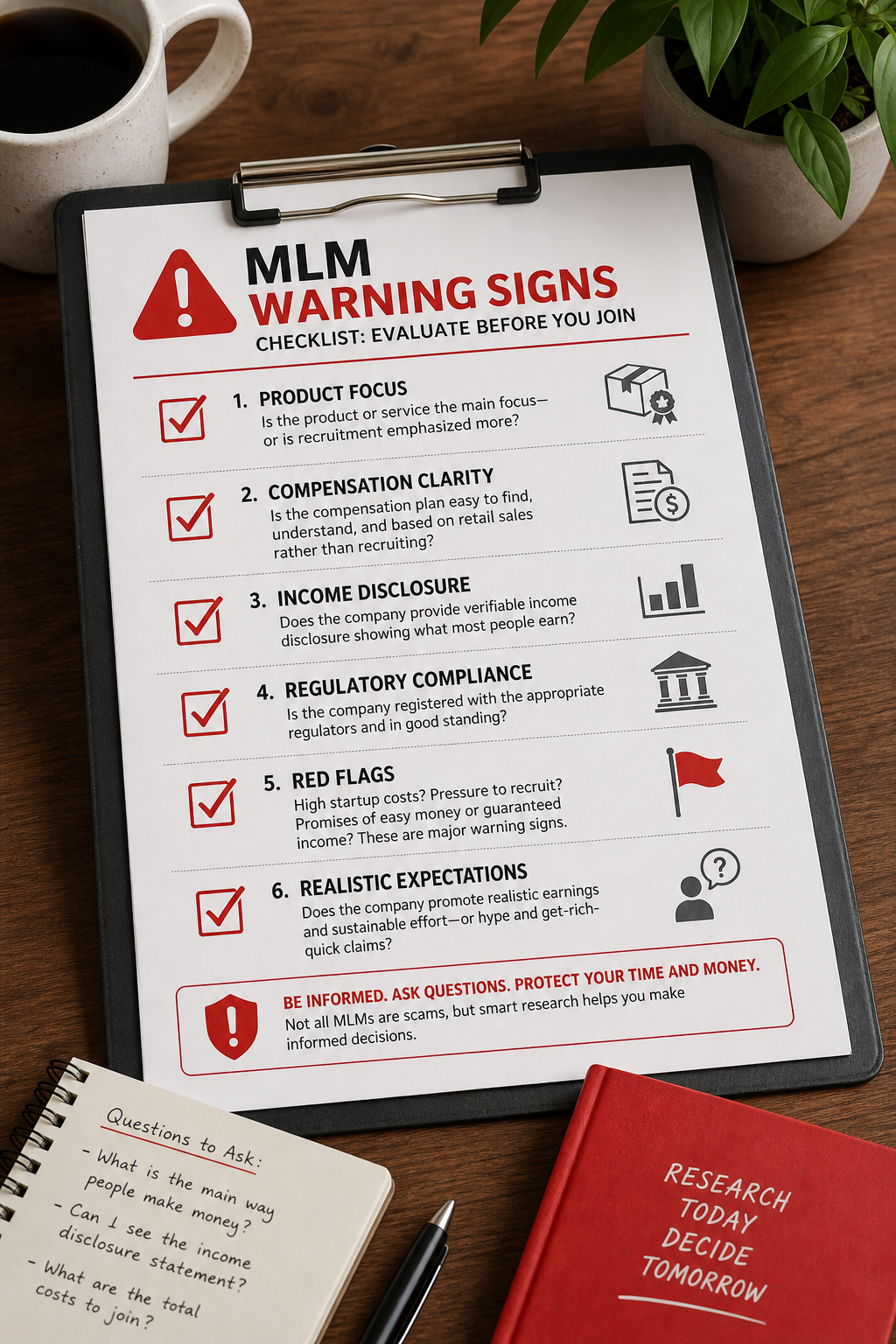
Here are the most common warning signs:
- Emphasis on recruitment over product sales:If the pitch sounds like “Earn money by inviting friends” more than “Sell a product you love,” step back.
- Huge upfront inventory purchases:Requiring you to buy large amounts of stock before you can sell is a classic trap.
- Lack of transparent earnings data:Legitimate companies publish average earnings disclosures or at least a range.
- Vague or missing compensation plan details:If the company won’t show you the exact percentages, you’re in the dark.
- Pressure tactics:High‑pressure seminars that demand immediate sign‑up are a red flag.
To protect yourself, follow this step‑by‑step due‑diligence process:
- Read the official compensation plan document. Look for clear level‑by‑level percentages.
- Search for independent reviews or regulatory actions. The FTC’s website often lists cases against companies that cross the line.
- Ask for real sales data. A reputable MLM will share average sales numbers for new distributors.
- Start with a minimal starter kit. Treat it like a test run before you invest heavily.
- Join a community of distributors and ask tough questions. If they can’t answer, that’s a warning sign.
Below is a short video that walks through these red flags in plain language.
And remember, you can always compare mentorship options. The Shush Arya Coaching Program stands out for its transparent pricing and clear delivery method, unlike many competitors that hide those details.
FAQ
What does MLM stand for?
MLM is short for multi‑level marketing. It describes a sales model where you earn commissions both on the products you sell personally and on the sales made by the people you recruit into your network.
Is every MLM a pyramid scheme?
No. A legitimate MLM sells real products to end‑customers and pays commissions based on those sales. A pyramid scheme, by contrast, mainly rewards recruitment fees and often lacks a genuine product. The FTC provides clear guidelines to tell the two apart.
How much money can I realistically make?
Earnings vary widely. Some top distributors earn six‑figure incomes, but most participants earn modest amounts or break even. Success depends on your sales skill, the strength of your downline, and the market demand for the product.
Do I need to buy inventory up front?
Many MLMs require a starter kit, but the size and cost differ. Look for companies that let you begin with a low‑cost kit and that offer a buy‑back or return policy for unsold inventory.
Is the business model legal?
Yes, MLMs are legal in most countries as long as they comply with regulations that require genuine product sales and transparent compensation. Illegal pyramid schemes violate these rules and can result in fines or shutdowns.
How can I tell if an MLM is reputable?
Check for a clear compensation plan, published earnings disclosures, a real product line, and positive reviews from independent sources. Also, verify that the company is registered with consumer protection agencies and that it has no recent legal actions against it.
Conclusion
Understanding the MLM meaning is the first step toward making an informed decision. We’ve covered how the model works, the legal line that separates MLMs from pyramid schemes, the upside and downside of participation, and the warning signs that keep you safe. If you feel the structure matches your goals, consider a mentorship that offers both mindset coaching and concrete sales tactics, like the Shush Arya Coaching Program, which spells out exactly how to grow a network‑marketing business.
Ready to dive deeper? Explore our ultimate guide to creating massive success in network marketing for step‑by‑step strategies and real‑world examples.


